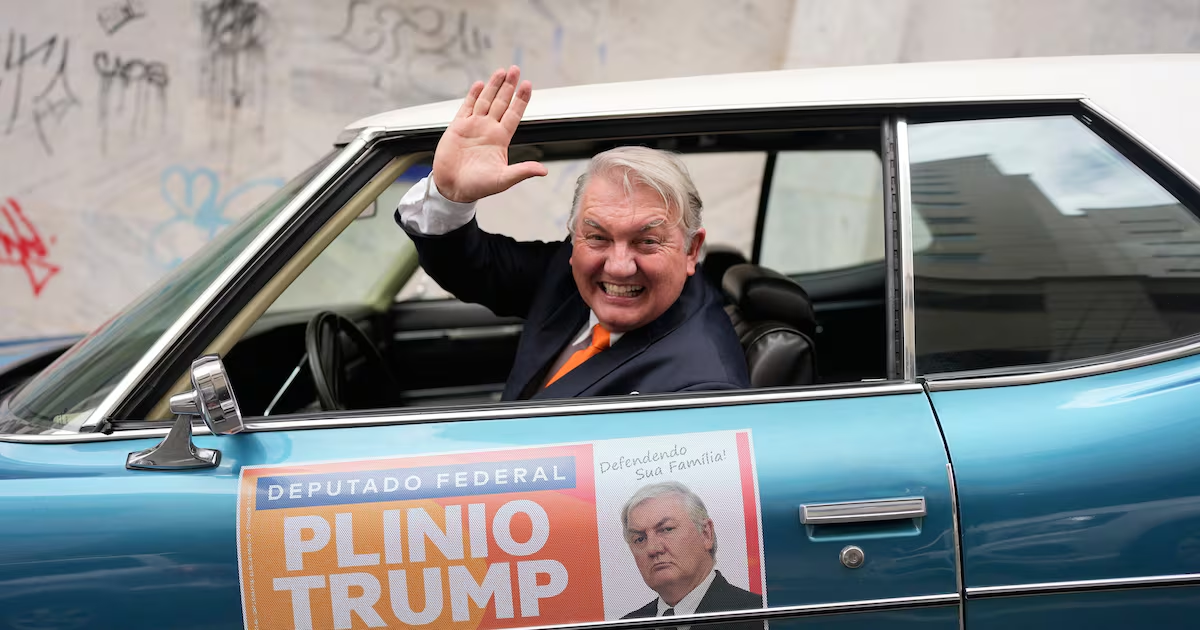
When a vintage Pontiac Grand Ville rolls through the streets of Minas Gerais with an American flag fluttering from the hood, onlookers might mistake the scene for a presidential motorcade from a different hemisphere. Behind the wheel is Plínio Vicentin Júnior, a 59-year-old helicopter pilot making his first run for Congress. However, on the ballot and in the eyes of the public, he is “Plínio Trump.” Sporting the signature coiffure, a long orange necktie, and the deliberate gait of the former U.S. President, Júnior is the latest face in a long-standing Brazilian electoral tradition: the “joke” or novelty candidate.
What happened
In the current Brazilian election cycle, thousands of candidates are vying for seats in state legislatures and Congress. Among the serious political hopefuls is a surreal subculture of individuals who campaign under the personas of celebrities, fictional characters, or bizarre aliases. Plínio Trump is perhaps the most visible, successfully courting smiles and handshakes from voters who find his impersonation of Donald Trump iconic rather than offensive.
He is far from alone. In the state of Goiás, a carpenter named Wallyson Vieira has transformed into “Mick Jagger,” complete with shaggy hair and tight clothing. Elsewhere, voters can find “Samurai Taxi Driver,” a nunchuck-wielding figure from Paraná, and even “Barack Obama,” a perennial candidate in the Federal District who has spent years perfecting his resemblance to the 44th U.S. President. These figures often utilize catchy nicknames or social media stunts to gain traction in a crowded field of over 28,000 candidates nationwide.
Context
The phenomenon of the “joke candidate” is not a modern anomaly in Brazil; it is a storied tradition that spans more than six decades. One of the most famous instances occurred in 1959, when voters in São Paulo wrote in the name of a rhinoceros named Cacareco from the local zoo. The animal “won” roughly 100,000 votes, a clear signal of the electorate’s disdain for the available human options.
In more recent history, the cardiologist Dr. Enéas Carneiro became a household name in the 1990s for his 15-second, rapid-fire television spots that ended with the iconic shout: “My name is Enéas!” In 2010, a professional clown known as Tiririca won a seat in Congress with the slogan, “It can’t get any worse than it is.” To run, these candidates must meet the same legal requirements as any other politician, including joining a political party and maintaining a clean criminal record.
Why it matters
While these candidates often appear lighthearted, their presence in the race serves a significant dual purpose within the Brazilian political system. For the voters, casting a ballot for a “Samurai Taxi Driver” or “Plínio Trump” is a way to express profound disillusionment with traditional politics. In a system where voting is mandatory, these figures provide a “protest” outlet for those who feel the establishment no longer represents them.
For political parties, however, these novelty candidates are often strategic assets. Brazil’s proportional representation system means that “vote-pullers” like Tiririca or Enéas can bring in thousands of “extra” votes. These surplus votes are then distributed to other members of the same party or coalition who might not have received enough individual support to win a seat. Furthermore, a higher total vote count for a party translates into more public funding and more airtime for future campaigns.
While critics argue that these candidates mock the seriousness of democratic governance, their continued popularity highlights a persistent gap between the Brazilian public and its traditional political leaders. As long as voters feel unheard, the “joke candidates” will likely remain a very serious part of Brazil’s electoral landscape.