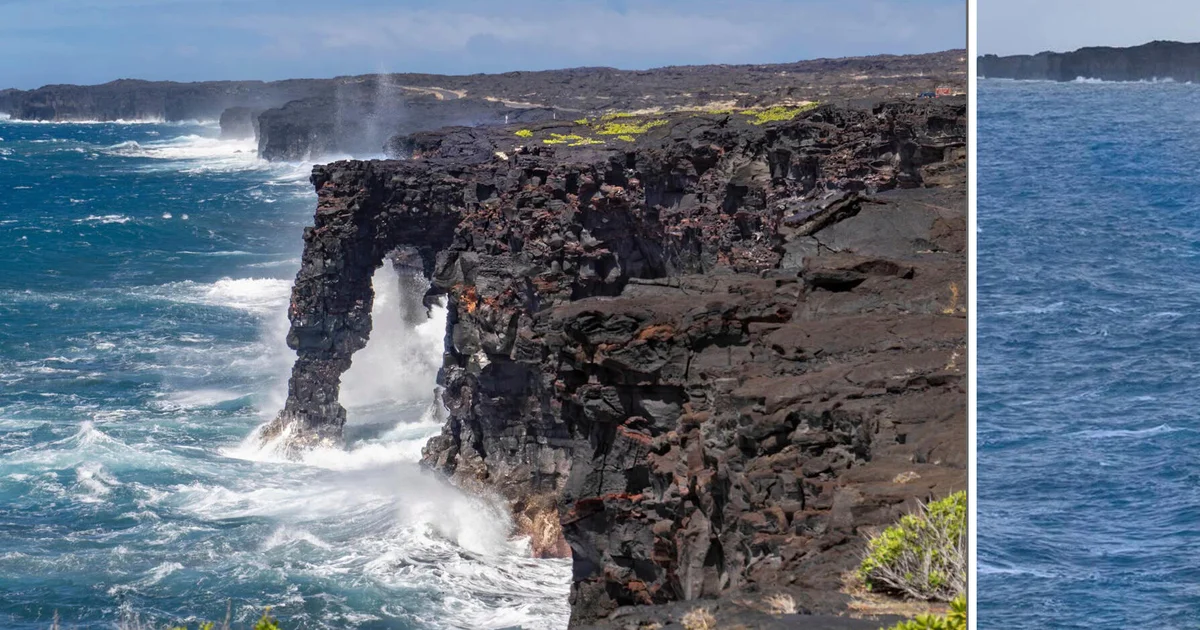
A legendary fixture of the Hawaiian coastline has vanished into the sea, marking the end of a geological era for the Big Island. The Holei Sea Arch, a towering basalt bridge that served as one of the most photographed landmarks in Hawaii Volcanoes National Park, has officially collapsed. For more than five centuries, this natural monument stood as a testament to the island’s volcanic origins and the sheer power of the Pacific Ocean, but officials confirmed this week that the structure is no longer standing.
What happened
National Park Service (NPS) officials report that the collapse likely occurred between September 23 and September 27, 2026. While the exact moment of the arch’s demise remains unknown, experts believe it may have coincided with the passage of Tropical Storm Nolo. The storm brought devastating conditions to the region, featuring heavy rainfall and sustained winds reaching 155 mph. At the time of the incident, the park had been temporarily closed to ensure public safety during the peak of the weather event.
Before its fall, the Holei Sea Arch reached a height of approximately 90 feet. Following the storm, park rangers discovered that the massive bridge of rock had been swallowed by the waves, leaving only a jagged cliffside behind. While the loss of such a famous site is significant, park officials emphasized that the terrain remains extremely unstable. They have issued stern warnings for visitors to avoid the area, as the remaining cliff edges are prone to further crumbling, posing a lethal risk to anyone attempting to view the site from the perimeter.
Context
The Holei Sea Arch was a relatively young feature in geological terms, having formed roughly 550 years ago. It was created through a process of differential erosion, where the relentless energy of the ocean hammered away at the base of a volcanic cliff until a hole was punched through, leaving a bridge of hardened lava. The name “Holei” is derived from a rare endemic plant in the milkweed family that is native to the region.
This collapse follows a particularly brutal season for the Hawaiian Islands. Only a month prior, the state was battered by Hurricane Lala, which caused significant infrastructure damage, triggered landslides, and destroyed dozens of homes. The cumulative impact of these successive storms likely weakened the already fragile basalt structure. The NPS noted that while the arch’s disappearance is a loss for tourism, it is a normal part of the coastline’s “rugged and remote” evolution.
Why it matters
The destruction of the Holei Sea Arch serves as a stark reminder of the temporary nature of Earth’s coastal features. Geologists have long categorized the arch as a transitory formation with a finite lifespan. Its collapse represents the latest chapter in the ongoing transformation of the Big Island’s landscape, where volcanic activity creates new land and the ocean eventually reclaims it.
Beyond the geological significance, the event has raised urgent safety concerns. Despite official closures and warnings, images have surfaced on social media showing individuals bypassing safety barriers to document the aftermath. Park officials have reiterated that such actions put both the public and emergency responders in unnecessary danger. As the coastline continues to settle and adjust to the loss of the arch, the National Park Service is focusing on monitoring the stability of the surrounding cliffs to prevent further accidents. The arch may be gone, but the natural processes that created it continue to reshape the Hawaiian coast every day.