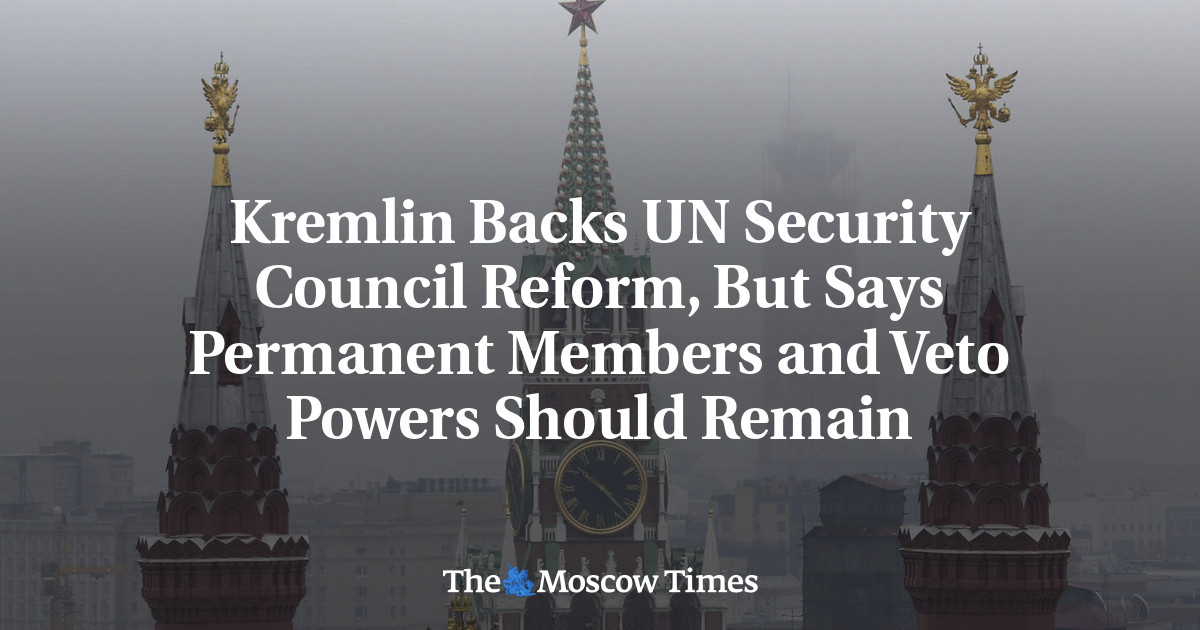
Moscow has expressed a cautious willingness to see the United Nations Security Council evolve, provided that its core power structure remains largely intact. Kremlin spokesperson Dmitry Peskov recently confirmed that while Russia acknowledges the necessity of reform to reflect modern global realities, it considers the existing permanent membership model and the associated veto rights to be non-negotiable pillars of the international organization. This stance comes as global leaders gather for the General Assembly, where the effectiveness and fairness of the UN’s highest body are under intense scrutiny.
What happened
During a daily press briefing, Peskov articulated the Russian government’s specific vision for a reformed Security Council. He noted that the Kremlin is open to discussions about increasing the number of permanent seats on the council, a move that would theoretically allow for broader representation. However, he was quick to clarify that the fundamental “institution” of permanent membership and the right to veto resolutions must be preserved.
According to the Kremlin, these elements are vital to the structural integrity and stability of the United Nations. This announcement serves as a direct response to growing international pressure for change, most notably from Turkish President Recep Tayyip Erdoğan. Ahead of the 81st UN General Assembly, Erdoğan reiterated his long-standing demand for a complete overhaul of the system, calling for the elimination of both permanent seats and the veto privilege to create a more equitable global governance model that is not “limited to five countries.”
Context
The debate over Security Council reform is a decades-old issue that has gained significant momentum due to recent geopolitical gridlock. The council is currently dominated by five permanent members (the P5): China, France, Russia, the United Kingdom, and the United States. Because any one of these nations can block a resolution with a single vote, the body has often found itself paralyzed during major conflicts where the interests of the P5 clash.
In recent years, the council’s inability to act has been highlighted by the war in Ukraine, where Russia’s own veto power has been a primary obstacle to any UN-led intervention or formal condemnation. Simultaneously, other reform initiatives are gaining traction. A proposal spearheaded by France and Mexico seeks to voluntarily restrict the use of the veto in instances involving mass atrocities. This movement received a significant boost recently when the United Kingdom officially endorsed the declaration. Currently, the initiative is reportedly just one vote shy of reaching a two-thirds majority among the broader UN membership, signaling a deep-seated frustration with the status quo.
Why it matters
This development highlights the ongoing tension between traditional power dynamics and the push for a more “multipolar” world order. By supporting an increase in the number of permanent members while simultaneously clinging to the veto, Russia is attempting to navigate a middle ground. It signals a willingness to include more voices—potentially from allies in the Global South—while ensuring that the ultimate authority remains in the hands of the original power brokers.
For Moscow, the preservation of the veto is a matter of national security and diplomatic leverage. Without it, the UN could pass binding resolutions that directly challenge Russian military or political interests without any legal recourse for the Kremlin to stop them. As the General Assembly convenes this week, the central question remains whether the UN can remain relevant in an era of deep division. With high-level discussions scheduled to address topics ranging from artificial intelligence to the escalating crises in the Middle East, the structural limitations of the Security Council will likely remain the most significant hurdle to effective collective global action.