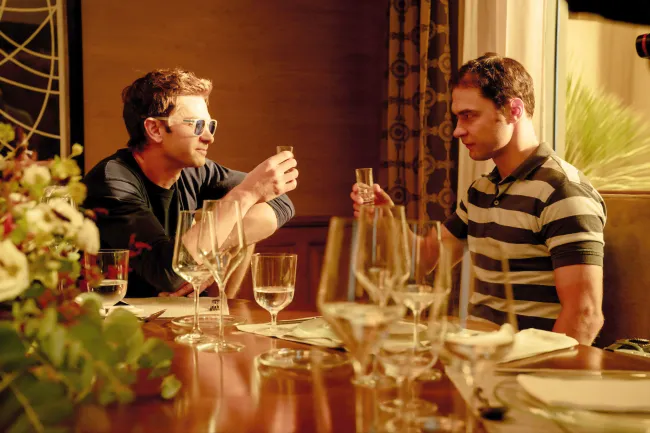
The 2026 New York Film Festival recently played host to the world premiere of Artificial, a biting and surreal look at the rise of OpenAI. Directed by Luca Guadagnino, the film is already being hailed as the spiritual successor to The Social Network, trading the collegiate betrayals of early social media for the existential dread of the silicon age. With a script by Simon Rich and a haunting musical introduction by Damon Albarn, the film positions the race for artificial general intelligence (AGI) not as a triumph of human ingenuity, but as a campy, tragic descent into techno-nihilism.
What happened
Artificial follows the turbulent history of OpenAI, focusing specifically on the friction between visionary idealism and corporate ruthlessness. Andrew Garfield delivers a transformative performance as CEO Sam Altman, portraying him as a calculated, power-hungry figure with a chillingly detached view of the human species. Opposite him, Yura Borisov plays Ilya Sutskever, the brilliant but increasingly paranoid scientist who serves as the film’s moral compass.
The narrative tracks the company’s evolution from its non-profit beginnings to its eventual multi-billion-dollar partnership with Microsoft. Along the way, Guadagnino infuses the story with his trademark focus on the physical body, highlighting the contrast between the coldness of the algorithms being written and the sweaty, anxious reality of the people writing them. The film culminates in a dramatization of the infamous board coup and Altman’s subsequent return, framed as a moment of finality for the ethical guardrails that once defined the project.
Context
While David Fincher’s The Social Network focused on a young man’s desire for social acceptance, Artificial deals with a much larger scale of consequence. The film explores the “San Francisco camp” of Silicon Valley, where billionaires speak in spiritual platitudes while building tools that could potentially devalue human existence.
The casting choices underscore this disconnect. Mark Rylance appears as the eccentric “Godfather of AI,” Geoffrey Hinton, while Ike Barinholtz offers a satirical, uncomfortable take on Elon Musk. The screenplay by Simon Rich moves from lighthearted spoof to a genre-bending psychological thriller, drawing comparisons to classic cautionary tales like Invasion of the Body Snatchers. By the time the film reaches its third act, the focus shifts to the internal politics of the OpenAI board, presented as a frantic, ice-cold power struggle for the future of the planet.
Why it matters
Artificial arrives at a time when the real-world impact of generative AI is a subject of intense global debate. Guadagnino’s film argues that the flaws inherent in artificial intelligence are merely reflections of the flaws in its creators. The “hallucinations” and deceptions of the software are mirrored in the duplicity and ambition of the characters, suggesting that we have encoded our worst impulses into the “superintelligence” we hope will save us.
The film distinguishes itself by refusing to lionize its subjects. Where previous biopics might have looked for a redemptive arc, Artificial leans into a biblical nihilism. It presents Sam Altman not just as a difficult leader, but as a figure who has transcended traditional morality in pursuit of a digital godhood. As the film moves toward its Christmas Day release via NEON, it serves as a stark, cinematic warning: the technology we are building is only as good as the people behind it, and Artificial suggests those people may be fundamentally broken.