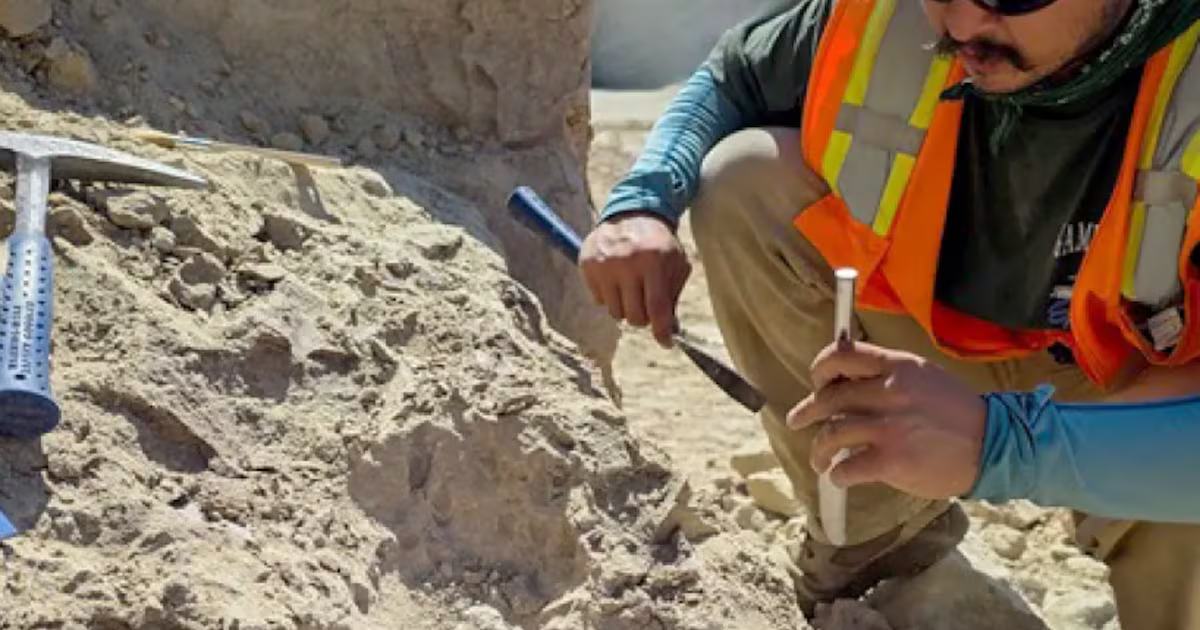
A routine infrastructure project in Oceanside, California, recently transformed into a significant archaeological investigation after workers unearthed the remains of a massive prehistoric creature. Buried approximately 12 feet beneath the surface, the fossilized bones represent a window into a world that existed roughly 40 million years ago. While the discovery has sparked excitement among the scientific community, the exact identity of the creature remains a subject of intense debate, as the specimen is missing the most diagnostic parts of its anatomy.
What happened
The discovery occurred on August 31 during an excavation for a local water infrastructure project. While digging through the earth, construction crews struck a layer of fossilized remains located deep underground. Work was paused to allow specialists to examine the site, leading to the recovery of several significant skeletal fragments. According to statements from the city of Oceanside, the find includes large limb bones, ribs, and various other fragments that appear to belong to a single, massive individual.
Paleontologist Joseph El Adli, who has been examining the remains, noted that the fossils are in relatively good condition considering their age, though they are incomplete. The primary challenge facing researchers is the absence of a skull. In paleontology, the skull and teeth are often the “smoking gun” needed to identify a species, as they reveal specific dietary habits and evolutionary lineages. Without these crucial pieces, experts can only narrow the animal’s identity down to a few likely candidates based on the size and structure of the recovered limb bones.
Context
The fossils were found within the Santiago Formation, a geological layer in Southern California renowned for its rich deposits of Eocene epoch fossils. During this period, the region’s climate and landscape were vastly different than they are today, providing a lush environment for a variety of experimental mammalian lineages.
Based on the size of the bones, El Adli has proposed two primary theories. The first possibility is that the creature is a “thunder beast,” technically known as a brontothere. These were massive, hoofed herbivores that resembled modern rhinoceroses but were actually more closely related to horses. They were characterized by their immense bulk and, in many species, elaborate bony horns.
The second possibility is that the remains belong to a “swamp rhino,” or amynodont. Unlike the desert-dwelling rhinos people might imagine today, amynodonts were barrel-bodied herbivores that spent much of their time in the water, similar to modern hippopotamuses. Both groups were prominent during the late Eocene, and finding a specimen of this size provides valuable data regarding the megafauna that once dominated the West Coast.
Why it matters
This discovery highlights the critical role that “mitigation paleontology” plays in modern urban development. In many parts of California, law requires paleontological monitoring during large-scale excavations because of the high likelihood of hitting fossil-rich strata. Without these regulations, this 40-million-year-old inhabitant of Oceanside might have been lost to history, crushed by heavy machinery before it could be studied.
Furthermore, identifying this specific animal could help scientists better understand the environmental transitions of the Eocene epoch. This was a time of significant climatic shifts, and knowing whether this creature was a land-based brontothere or a semi-aquatic amynodont would offer clues about the local ecosystem’s water levels and vegetation millions of years ago.
For now, the team is keeping a close watch on the ongoing excavation. El Adli remains hopeful that as the project continues, workers might find the animal’s lower jaw or teeth. Such a find would provide the definitive evidence needed to solve the mystery. Until then, the “Oceanside Giant” remains a tantalizing enigma of California’s prehistoric past, reminding us that an ancient world lies just beneath the pavement of our modern cities.