More than a decade after the Academy Award-winning The Social Network redefined the tech biopic, screenwriter Aaron Sorkin has returned to the world of Silicon Valley with a spiritual successor. While the 2010 original focused on the cutthroat origins of Facebook within the gates of Harvard, The Social Reckoning shifts its lens to the modern era of whistleblowers and corporate accountability. However, despite the high-stakes subject matter and a star-studded cast, the film struggles to recapture the cinematic lightning that made its predecessor a modern classic.
What happened
Directed and written by Sorkin, The Social Reckoning dramatizes the real-world events surrounding the “Facebook Files.” The narrative follows Jeff Horwitz (Jeremy Allen White), an investigative reporter for the Wall Street Journal, as he attempts to peel back the layers of secrecy at the social media giant. His efforts lead him to Frances Haugen (Mikey Madison), a member of the company’s Civic Integrity team who decides to leak internal documents revealing how the platform’s algorithms contributed to radicalization and mental health issues among teenagers.
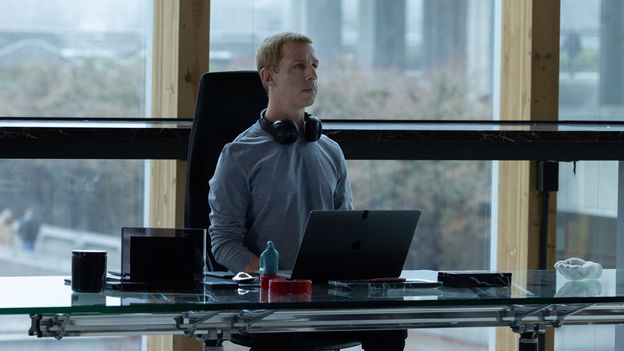
The film utilizes a dual-timeline structure. One strand follows the clandestine meetings between Horwitz and Haugen as they build their case, while the other focuses on Mark Zuckerberg—now played by Jeremy Strong—as he prepares for a high-profile Senate hearing. Strong’s portrayal of the CEO is a stark departure from Jesse Eisenberg’s petulant, energetic performance in the first film; here, Zuckerberg is depicted as a cold, detached figure who remains largely isolated from the main action.
Critics have noted that the film feels surprisingly low-energy for a thriller. While the dialogue retains Sorkin’s signature wit and rapid-fire delivery, the lack of physical stakes or direct conflict between the protagonist and the antagonist leaves the story feeling stagnant. Despite the heavy themes, the film often boils down to a series of conversations in dimly lit rooms that fail to generate the necessary tension for a “crusading journalist” drama.
Context
To understand the disappointment surrounding The Social Reckoning, one must look at the legacy of The Social Network. Directed by David Fincher, the original film was a masterclass in pacing and atmosphere, turning a legal dispute over intellectual property into a high-stakes psychological drama. In this sequel, Sorkin takes the director’s chair himself, but his approach lacks the visual dynamism and kinetic energy that Fincher originally brought to the material.
The film arrives during a period of intense cinematic interest in the tech industry’s elite. It joins a roster of recent and upcoming projects, such as Alejandro G. Iñárritu’s Digger starring Tom Cruise, and Luca Guadagnino’s Sam Altman biopic, Artificial. While these films attempt to grapple with the immense power held by modern industrialists, The Social Reckoning feels more like a historical retread than a provocative new statement. It also faces the challenge of dramatizing events that are still fresh in the public’s memory, making the “revelations” within the script feel like old news to many viewers.
Why it matters
The failure of The Social Reckoning to land a significant emotional or narrative punch is particularly notable given the importance of its themes. The film highlights critical issues, such as internal research showing that 32% of teenage girls felt worse about their bodies after using Instagram—a platform owned by Facebook. By failing to create a compelling cinematic experience, the movie risks trivializing the very real societal damage it aims to expose.
Furthermore, the film highlights the difficulty of creating a “triumph” narrative in the tech world. Unlike All the President’s Men or Spotlight, where the journalistic investigation leads to a tangible downfall or systemic change, The Social Reckoning ends on a somber note. Zuckerberg remains one of the wealthiest individuals on the planet, and his platforms continue to dominate global communication. This lack of a true “reckoning” leaves the audience with a sense of futility, suggesting that even the most damning whistleblowing may not be enough to shift the power of Big Tech. Ultimately, while Sorkin’s latest effort provides a competent summary of recent headlines, it fails to influence the conversation in the way its predecessor did.