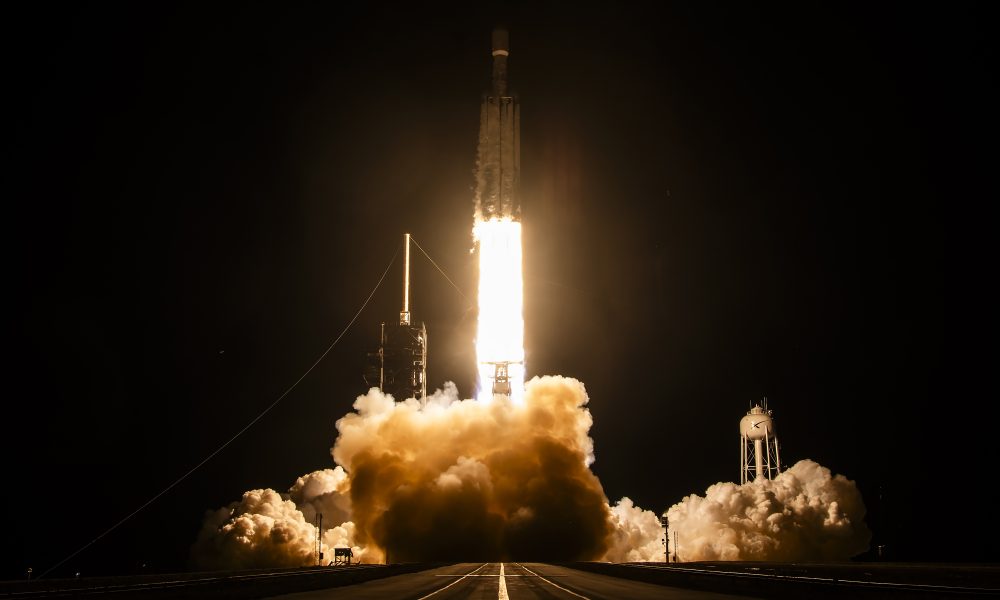
Under the cover of a midnight sky, SpaceX recently achieved a historic milestone that further solidifies its dominance in the aerospace industry. By successfully executing its first-ever mission for the National Reconnaissance Office (NRO) using a Falcon Heavy rocket, the company did more than just deliver a classified payload into orbit. This mission served as the anchor for a remarkable operational feat: the successful recovery of four orbital-class rocket boosters within a single calendar day. The achievement highlights the incredible cadence and reliability that SpaceX has brought to modern spaceflight.
What happened
The record-breaking sequence began with the launch of the NROL-70 mission from the Kennedy Space Center in Florida. The Falcon Heavy, currently one of the most powerful operational rockets in the world, lifted off with its signature roar, carrying a secret spy satellite for the United States government. As the mission progressed, the rocket’s two side boosters separated and performed synchronized “boost-back” maneuvers, eventually touching down simultaneously at SpaceX’s Landing Zones 1 and 2.
These two successful landings were the final pieces of a larger puzzle. Earlier in the same 24-hour window, SpaceX had already completed two other Falcon 9 launches, each involving its own successful booster recovery. When the Falcon Heavy side boosters touched down, it officially brought the daily total to four successful landings. This surpassed the previous company record and demonstrated an unprecedented level of logistical and technical coordination, effectively proving that SpaceX can manage multiple high-stakes missions and recoveries across different launch pads in rapid succession.
Context
The Falcon Heavy has long been the centerpiece of SpaceX’s heavy-lift capabilities, consisting of three liquid-fueled Falcon 9 engine cores strapped together. While the Falcon 9 is the workhorse of the fleet, the Heavy is reserved for massive payloads or missions requiring high-energy orbits, such as those demanded by the NRO and the Department of Defense.
Historically, highly classified national security missions were the exclusive domain of legacy providers. However, over the last few years, the Pentagon has increasingly leaned on Elon Musk’s aerospace firm to handle sensitive government assets. This specific NRO mission marks a significant transition, as it proves that even the most complex and secretive government payloads can be safely integrated with reusable rocket technology. The ability to reuse boosters not only lowers the price point for the taxpayer but also ensures a faster turnaround time for urgent defense needs.
Why it matters
The implications of this record-breaking day extend far beyond a simple tally of successful landings. First and foremost, it validates the maturity of SpaceX’s recovery hardware. Landing four boosters in one day suggests that the process has become nearly routine, shifting from a high-risk experimental endeavor to a standard operational procedure. This reliability is exactly what the U.S. military requires when launching multi-billion dollar reconnaissance equipment.
Furthermore, this achievement sets a new benchmark for launch frequency. As the global demand for satellite deployment—both commercial and military—continues to skyrocket, the ability to process and recover multiple vehicles in a single day is a critical competitive advantage. It signals to both government agencies and private enterprises that the bottleneck of space access is rapidly dissolving. By proving that they can land four boosters in 24 hours, SpaceX has demonstrated that the future of space exploration will be defined by rapid reusability and an almost industrial-scale approach to reaching the stars.