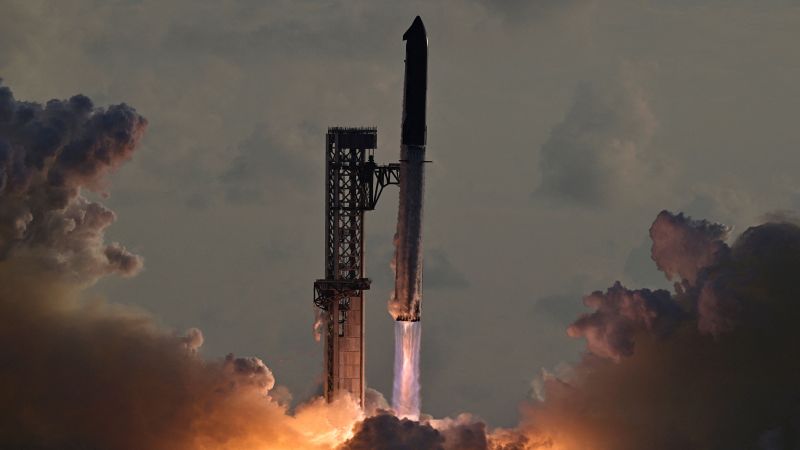
SpaceX’s Starship, the most formidable launch vehicle ever constructed, reached a significant milestone this week by successfully achieving orbit during its latest test flight. Departing from the Starbase facility in Texas, the mission demonstrated the immense power of the Starship system while providing critical data on its orbital capabilities and reentry resilience. Although the flight was not without its technical challenges, the achievement marks a pivotal step forward for SpaceX’s ambitions to dominate deep-space exploration.
What happened
The flight began with a successful liftoff from the Texas coast, as the massive rocket climbed toward space. A primary objective of the mission was the deployment of 26 operational Starlink satellites, which was completed successfully once the ship reached orbit. This confirmed the vehicle’s ability to carry and release heavy payloads into a stable orbital environment.
However, the mission did encounter some complications during the ascent. SpaceX confirmed that one of the spacecraft’s Raptor vacuum engines experienced a premature shutdown. This technical hiccup prompted flight controllers to adjust the mission timeline, opting to bring the vehicle back to Earth earlier than originally planned.
The return journey provided a dramatic spectacle as the Starship survived the intense heat of atmospheric reentry. As it approached the Pacific Ocean, the vehicle attempted a controlled landing burn. While the spacecraft reached the water, the splashdown was far more violent than the previous test in July. The high-velocity impact resulted in a significant fireball over the ocean, suggesting that while the controlled descent was functional, it lacked the “soft” touch seen in earlier iterations.
Context
The success of Starship is being closely monitored by NASA, which is under significant pressure to return humans to the lunar surface. During a news conference following the launch, NASA Administrator Jared Isaacman praised the progress, noting that Starship’s development is essential for the upcoming Artemis missions. SpaceX is currently working toward a critical NASA test flight scheduled for next year, which serves as a prerequisite for the next crewed moon landing.
This push for Starship’s maturity comes at a time of transition for the American space industry. While SpaceX currently relies on its Falcon 9 rockets and Dragon capsules to ferry astronauts and cargo to the International Space Station (ISS), the company intends to retire these older platforms to focus entirely on Starship. This transition creates a sense of urgency regarding other domestic launch options, specifically Boeing’s Starliner.
The Starliner program has faced a difficult road, most notably during a 2024 mission that left astronauts Butch Wilmore and Suni Williams at the ISS for nine months instead of their planned one-week stay. Because of Starliner’s ongoing technical struggles, SpaceX’s Dragon was ultimately required to bring those astronauts home. NASA has now established a new timeline for Boeing, aiming for an uncrewed test in December and a crewed mission by mid-2028.
Why it matters
The successful orbital reach of Starship is about more than just one rocket; it represents the future of the entire U.S. space infrastructure. If SpaceX follows through on its plan to sunset the Falcon and Dragon programs, the United States will be heavily dependent on Starship for deep-space missions and potentially on a refurbished Starliner for low-Earth orbit tasks.
Starship is designed to be a multi-purpose workhorse. Beyond its role in the Artemis moon program and potential Mars missions, the vehicle is expected to revolutionize the “orbital economy.” Its massive payload capacity could allow for the deployment of next-generation space telescopes, advanced national security assets, and the construction of a permanent lunar base.
As SpaceX refines the Raptor engines and perfects the splashdown sequence, every test flight brings the industry closer to a sustainable presence on the moon. The data gathered from this flight’s engine failure and the subsequent fireball will be instrumental in ensuring that when astronauts finally board Starship for a lunar mission, the vehicle is as reliable as the platforms it is destined to replace.