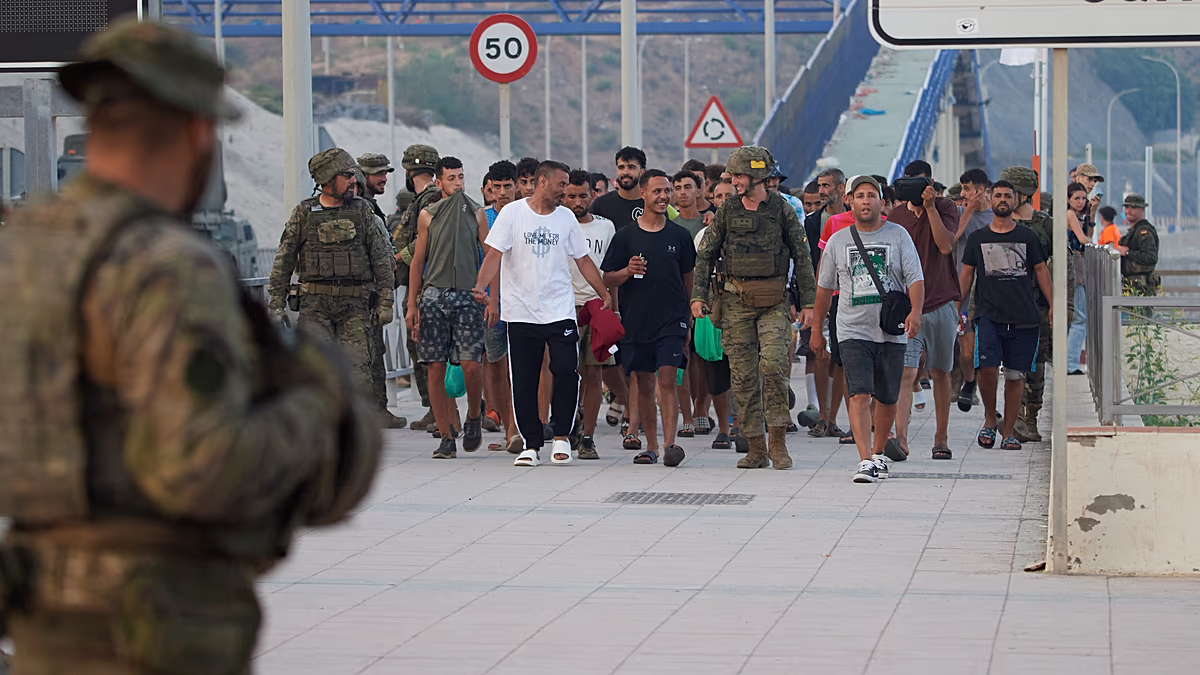
A significant political controversy has emerged in Spain following allegations that the national government was aware of an impending migrant crisis in the North African enclave of Ceuta long before it unfolded. While the administration has publicly maintained that the event caught them off guard, recent reports from internal sources suggest that intelligence agencies had provided ample warning. This discrepancy has raised serious questions about the government’s preparedness and its subsequent handling of a situation that Prime Minister Pedro Sánchez described as a direct threat to the nation’s sovereignty.
What happened
The core of the current controversy lies in a series of reports published by the Spanish media outlet ‘The Objective.’ According to their internal sources, the Spanish government received detailed intelligence briefings forecasting a massive surge of migrants attempting to cross into Ceuta. These reports allegedly outlined the scale and timing of the movement, providing the executive branch with the necessary information to bolster border defenses or engage in preventive diplomatic efforts.
However, when thousands of people eventually crossed the border into the Spanish territory, the government’s public stance was one of surprise and indignation. Prime Minister Pedro Sánchez reacted to the crisis by labeling the mass crossing a “violation of Spain’s territorial integrity.” Despite the gravity of this statement, the government has officially denied receiving any specific intelligence that would have allowed them to anticipate the magnitude of the surge. This denial now stands in direct opposition to the claims made by intelligence insiders, creating a narrative of potential negligence or a calculated political choice to downplay the warnings.
Context
Ceuta, along with Melilla, represents a unique geopolitical challenge as a Spanish enclave bordering Morocco. These territories serve as the only land borders between the European Union and Africa, making them frequent flashpoints for migration and diplomatic tension. Historically, the management of these borders relies heavily on cooperation between Spanish and Moroccan authorities, as well as the constant monitoring provided by Spain’s intelligence services.
The specific “surge” in question was not merely a humanitarian event but a major diplomatic incident. In the eyes of the Spanish administration, the scale of the crossing suggested a coordinated effort that transcended typical migration patterns. By describing the event as a violation of territorial integrity, Sánchez elevated the issue from a border management problem to a matter of national security. This context makes the allegations of ignored intelligence even more damaging, as it suggests the government may have been caught unprepared for a crisis that it later defined in the strongest possible sovereign terms.
Why it matters
This development is critical for several reasons, primarily concerning government accountability and the transparency of national security protocols. If the reports are accurate and the government did indeed ignore intelligence warnings, it suggests a significant failure in the chain of command or a breakdown in the communication between intelligence agencies and executive policymakers. In a democratic society, the public relies on the government to act on credible threats to national stability; a failure to do so, followed by a public denial, erodes trust in state institutions.
Furthermore, the situation has broader implications for European border policy. As the EU continues to debate how to secure its external frontiers, the incident in Ceuta serves as a case study in the complexities of southern border management. If Spain—one of the primary gatekeepers of the Mediterranean—cannot effectively utilize its intelligence to manage its enclaves, it raises concerns about the collective security of the Schengen Area.
Finally, the political fallout in Madrid is likely to intensify. Opposition parties have already begun to seize on the discrepancy between the intelligence reports and the government’s official narrative. For Pedro Sánchez, the challenge will be to reconcile his strong rhetoric regarding “territorial integrity” with the mounting evidence that his administration may have had the tools to mitigate the crisis before it ever reached the border fence. The resolution of this controversy will likely dictate the future of Spanish-Moroccan relations and the internal strategies used to police Europe’s most sensitive land borders.