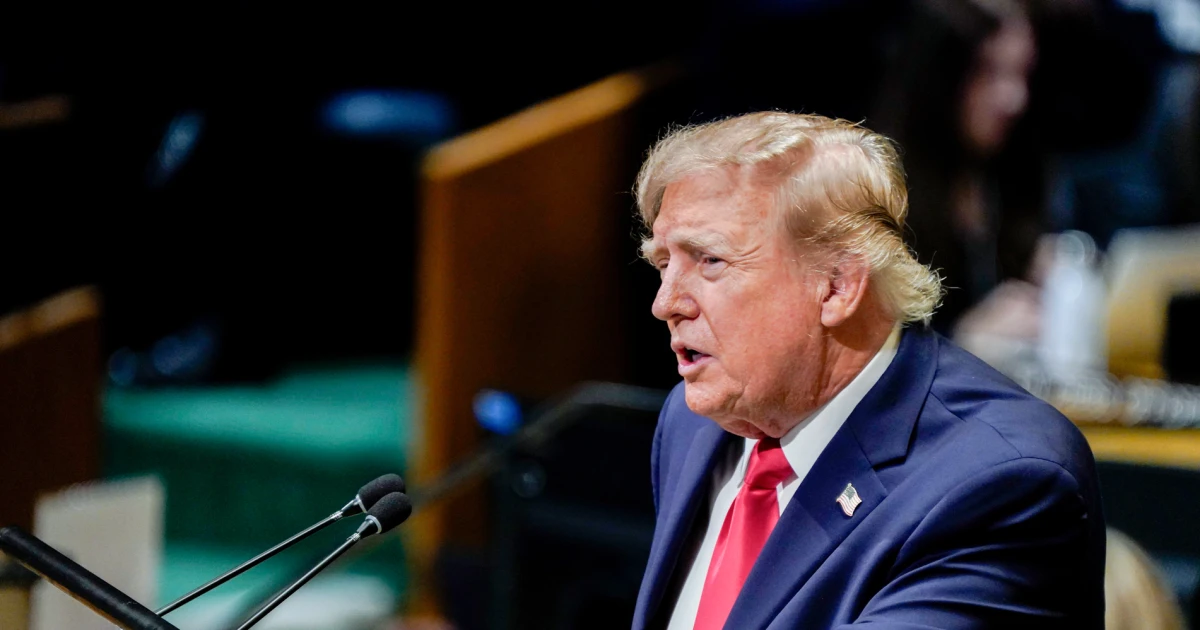
President Donald Trump’s recent address to the United Nations General Assembly delivered a series of pointed warnings to international adversaries alongside a vigorous defense of his domestic agenda. As global leaders gathered to discuss the future of international cooperation, the Trump administration also found itself embroiled in a domestic legal battle regarding the rights of the press. These parallel developments highlight a period of heightened tension both in American foreign policy and the administration’s relationship with the fourth estate.
What happened
During his wide-ranging speech at the United Nations, President Trump signaled a hardline stance toward Tehran, stating that the United States is prepared to “annihilate” Iran if necessary. While he expressed an openness to future negotiations, he remained skeptical that any diplomatic breakthrough would occur prior to the upcoming midterm elections. A central pillar of his address was the firm declaration that the Islamic Republic would never be permitted to acquire a nuclear weapon.
Beyond foreign policy, the President used the global stage to tout the strength of the American economy, labeling it “the envy of the world.” He also touched on emerging technologies, suggesting that the term “Artificial Intelligence” be rebranded as “superintelligence.” On the home front, the administration took a controversial step by banning news organizations including CNN, MSNOW, and Politico from White House access. The Department of Justice supported this move in a recent court filing, arguing that such access is a privilege rather than a constitutional right.
Meanwhile, domestic authorities are investigating a tragedy at the University of Mississippi. Two students were found dead in an incident that investigators believe may be connected to the use of kratom, a substance often referred to as a “gas station drug.”
Context
The President’s remarks at the UN come at a time of significant diplomatic maneuvering. He is scheduled to meet with several world leaders, including Chinese President Xi Jinping, to discuss trade disputes, the status of Taiwan, and the development of AI. His administration is also navigating shifts in South America, having recently met with Delcy Rodríguez following the capture of Nicolás Maduro earlier this year.
The legal justification for the media ban centers on allegations of national security breaches. The White House Press Office issued letters to the affected outlets, claiming their reporting on sensitive topics—such as the East Wing bunker construction, White House ballroom funding, and the impact of the Iran conflict on munitions stockpiles—amounted to the spread of falsehoods that endangered the country. This move has prompted an emergency hearing as news organizations seek a temporary order to restore their credentials.
Furthermore, while the President highlighted record-breaking stock market figures and tax reforms as evidence of economic success, the administration faces pressure over rising energy costs. With gas and diesel prices remaining at elevated averages, the economic narrative remains a point of contention among the American public.
Why it matters
The administration’s current trajectory has profound implications for both international stability and the constitutional interpretation of press freedom. The threat of “annihilation” toward Iran underscores an escalatory shift in Middle Eastern policy, placing the world on notice regarding the U.S. position on nuclear proliferation.
Domestically, the DOJ’s argument that White House access is a “privilege” challenges long-standing norms regarding the relationship between the executive branch and the media. If the court upholds the ban, it could set a precedent that allows future administrations to selectively exclude journalists based on the content of their reporting, potentially altering the landscape of the First Amendment. Additionally, as some Republican candidates begin to distance themselves from the President ahead of the midterms, the administration’s ability to maintain a unified front on these aggressive domestic and foreign policies will be put to the test.